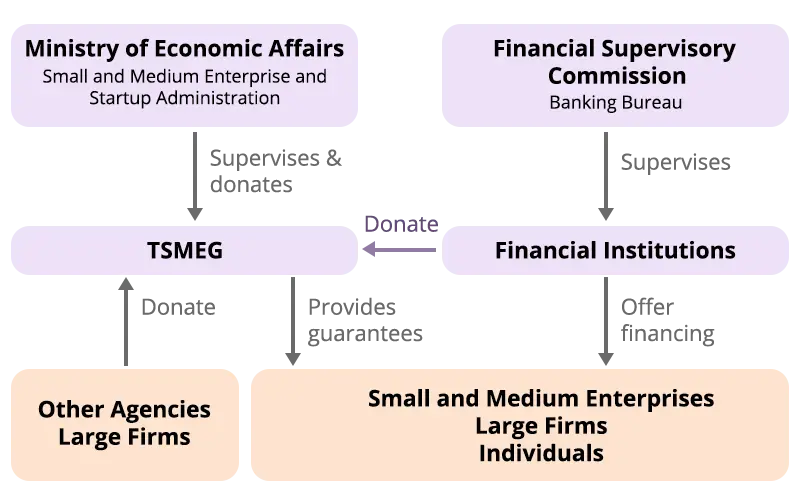
The main function of TSMEG is to provide credit guarantees to SMEs which are promising but short of collateral necessary to obtain finance from contracted financial institutions. There are three methods that TSMEG grants credit guarantees—Indirect Guarantee, Direct Credit Guarantee and Co-guarantee.
The risk-sharing arrangement is one of the features of TSMEG. Under the arrangement, apart from the portfolio credit guarantee and certain items of credit guarantee which TSMEG provides 100% guarantee, TSMEG takes partial risks of SME loans, and referring financial institutions are responsible for the rest (the smaller portion of the total lending risks).
There are two reasons for TSMEG to hold this policy. The first one is to request financial institutions to remain paying due attention to SME loan cases even though they are referred to TSMEG for credit guarantees. The second one is, by such arrangement, to expand guarantee capabilities to more SMEs.
The Credit Guarantee Services Dept. is functioning to provide consulting services in the areas of financing, management, accounting, corporation governace, etc. It aims to help SMEs to increase the efficiency of business operation, lower the capital cost of operation, extricate from predicaments, and improve the ability to secure loans and credit guarantees.
These consulting services are provided through phone calls, interviews, or visits on the clients' sites. TSMEG has established a TSMEG Institute which serves as a platform so that SMEs can share and exchange experiences. The institute began its operation in July 2005.
The objective of the TSMEG is to provide credit guarantees to those small and medium enterprises (hereafter referred to as “SMEs”) in normal operation but short of collateral for external financing. With guarantees provision, TSMEG helps these enterprises to smoothly secure financing from financial institutions (hereafter referred to as “FIs”). The operation of TSMEG is in line with the government’s financial and economic policies to assist SMEs.
SMEs play an extremely important role in Taiwan’s economic development. In early 1970s, a large number of SMEs suffered from the recession and inflation brought about by the oil crisis. At that time, the FIs turned to be conservative and requested very stringent collateral requirements on SMEs’ loan applications. SMEs thus encountered great difficulties in obtaining financing. To cope with these situations, TSMEG was established in 1974 to strengthen the financing assistance to SMEs.
Funds of the TSMEG come mainly from donations made by the central government, local governments, and contracted FIs. Up to the end of 2023, donations received have totaled NT$166.9 billion, 70% of which are from the central and local governments and 30% from the contracted FIs. As of the end of 2023, TSMEG’s net worth totaled NT$92.4 billion.
Corporate Status: A non-profit legal entity.
Law: The TSMEG was set up based on the Civil Code and also on a special permission granted by the Executive Yuan (the Cabinet).
Number of staff: About 330 (as of Jan, 2026)
Organization Chart (Download)